Celtic Zodiac Key-rings and Pendants

il_570xN.1469058749_72zj

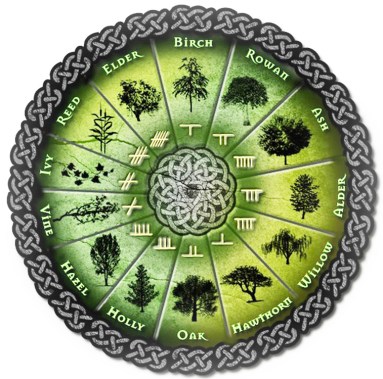
Celtic Astrology uses the cycle of the moon to create the zodiac. The year is broken into 13 months, each containing 28 days.
Each month is associated with a different tree, making 13 Celtic zodiac signs, and the symbol for each sign is the first letter of that tree in the Irish language written in Ogham.

Following this I have created celtic Zodiac photo glass cachobon key-rings.
The background in all of them is the Celtic Tree of Life.
There are 13 key-rings for the 13 Celtic Zodiac signs.
The back of the key-ring has a mandala design.
A description of your personality according to this Zodiac is included.

The specification of these key-ring is:
Size: 3 cm diameter, 9.5 length.
Metals Type:Zinc Alloy. Lead, Nickel, Cadmium free.
Color:Bronze.
Craft:Handmade

CLICK TO BUY

il_570xN.1469061853_l2ds

Celtic Astrology uses the cycle of the moon to create the zodiac. The year is broken into 13 months, each containing 28 days.
Each month is associated with a different tree, making 13 Celtic zodiac signs, and the symbol for each sign is the first letter of that tree in the Irish language written in Ogham.

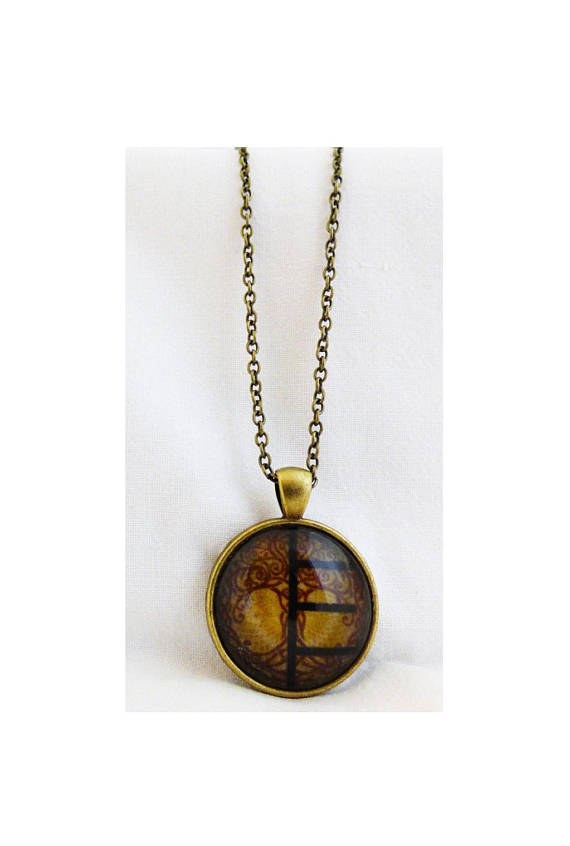
Following this I have created celtic Zodiac photo glass cachobon pendants.
The background in all of them is the Celtic Tree of Life.
There are 13 pendants for the 13 Celtic Zodiac signs.
The back of the pendant has a mandala design.
A description of your personality according to this Zodiac is included.

The specification of these pendants is:
Size: 2.5cm diameter with 50cm chain.
Metals Type:Zinc Alloy. Lead, Nickel, Cadmium free.
Color:Bronze.
Craft:Handmade

CLICK TO BUY

Wooden wall hanging with Ogham wish

il_570xN.1421496858_fahb

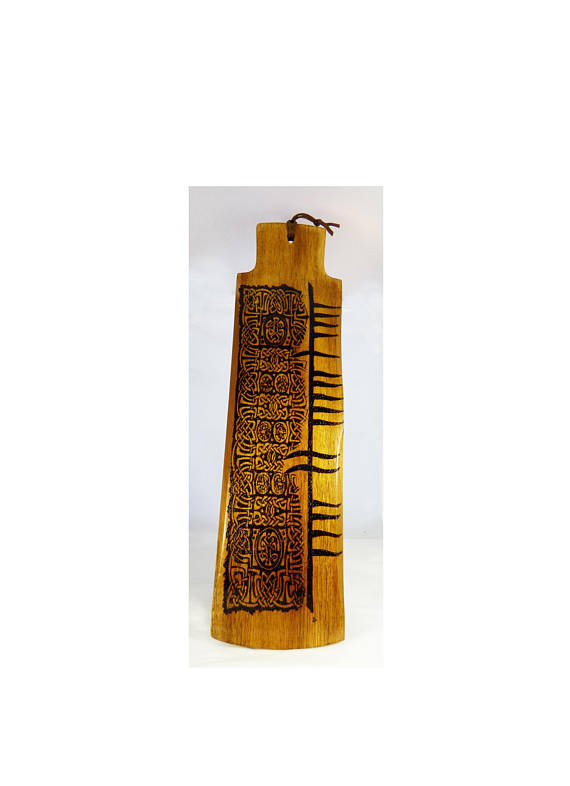
Hand crafted wooden wall hanging, in which a Celtic design and an Ogham wish have been pyrographed by hand.

Size: 48 cm long plus a leather cord 8cm and 13cm wide.

Varnished with strong and durable varnish.
To clean wipe with damp cloth.

Pyrography or pyrogravure is the art of decorating wood or other materials with burn marks resulting from the controlled application of a heated object such as a poker. It is also known as pokerwork or wood burning.

Available to buy Wall hanging


Ogham Alphabet

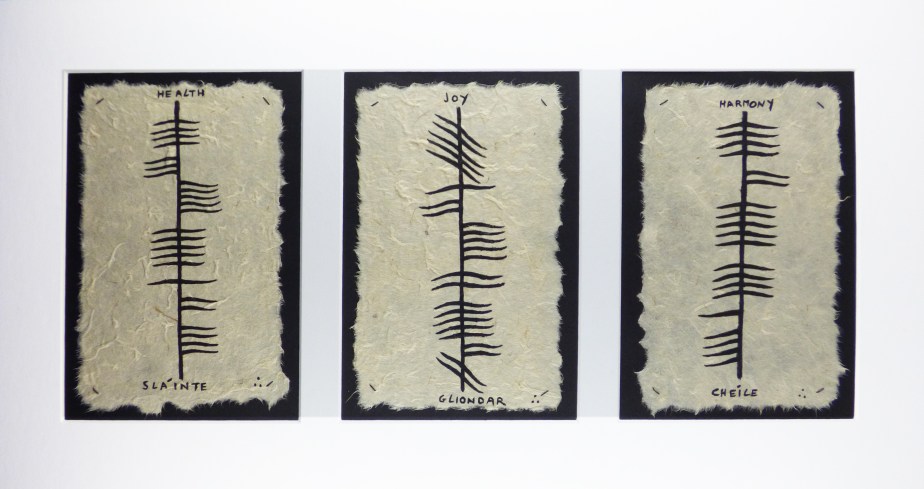
3 Ogham in 1

Ogham is an Early Medieval alphabet used primarily to write the early Irish language (in the so-called “orthodox” inscriptions, 4th to 6th centuries), and later the Old Irish language (so-called scholastic ogham, 6th to 9th centuries).

There are roughly 400 surviving orthodox inscriptions on stone monuments throughout Ireland and western Britain; south of Ireland, in Counties Kerry, Cork and Waterford.

A rare example of a Christianized Ogham stone can be seen in St Mary’s Collegiate Church Gowran Co. Kilkenny. The largest number outside of Ireland is in Pembrokeshire in Wales. The vast majority of the inscriptions consist of personal names.

Ogham is sometimes called the “Celtic Tree Alphabet”, based on a high medieval Briatharogam tradition ascribing names of trees to the individual letters. The etymology of the word ogam or ogham remains unclear. One possible origin is from the Irish og-úaim ‘point-seam’, referring to the seam made by the point of a sharp weapon.

CLICK TO BUY

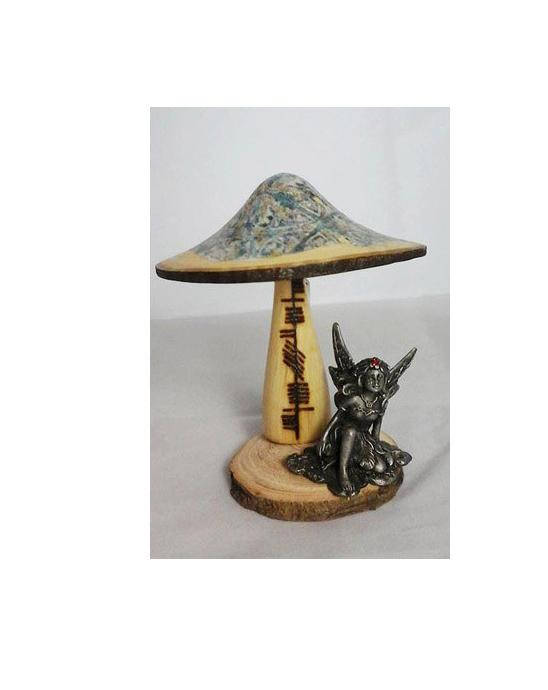
Fairy Rings: Myth and Nature

images-3

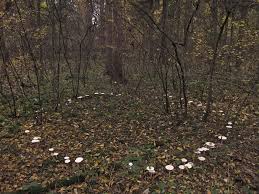
You have probably come across one of these as you walked through woodland somewhere.

You will have smiled at the strangeness of those mushrooms growing in a ring shape, as though avoiding the centre for some reason. Of course there is a perfectly logical, scientific explanation, but the fantasy is so much more interesting.

Fairy rings, as they have long been called, have occupied a popular place in folklore for thousands of years.

While science would call them naturally occurring rings of mushrooms, folklore tells us that these strange formations are actually the work of supernatural beings.

They are portals to other worlds or strange remnants of dancing faery folk. Of course, those are just stories, right?

Don’t ever step into a fairy ring

Fairy rings have other names: Elf Circles, Sorcerers or Witches Rings. The folklore surrounding these strange circles can be found in many cultures, each with slightly different variations.

For example, in German folklore, these rings are thought to be spots where witches dance on Walpurgis Night, a spring festival that lies exactly six months from All Hallows’ Eve.

In Celtic folklore, on the other hand, fairy rings are said to be caused by dancing faeries, or burned into the ground by dancing elves and left to appear in the morning after a moonlit night.

Whatever the case, it is said you should never enter a fairy ring, or else you will be cursed by their otherworldly protectors. You may even find yourself whisked away into the fairyland, or perhaps even driven mad.

Myths tell of mortal people entering fairy rings and suffering for it. Some believe that anyone stepping into an empty fairy ring will die young.Those violating fairy perimeters become invisible to those outside and may be unable to leave the circle.The fairies force intruders to dance till exhausted, dead, or in the throes of madness.

The only safe way, according to some beliefs, to investigate a fairy ring is to run around it nine times only (a tenth lap would nullify the effect). Doing this allows the runner to hear the fairies dancing underground. It must be done under a full moon, and in the direction the sun travels during the day.

It is also said that wearing a hat backwards confuses the fairies and stops them from doing the wearer any harm.

There are many sites in the UK where fairies are believed to be regular visitors, though always apparently at full moon. For example, “The Pixies’ Church” is a rock formation in Dartmoor surrounded by a fairy ring; and a stone circle at Cader Idris in Wales that is believed to be a popular spot for fairy dances.

A Devon legend says that a black hen and chickens sometimes appear at dusk in a large fairy ring on the edge of Dartmoor.

Victorian society believed that fairies, elves and witches were closely associated with one another, and malevolent towards humans. In Scotland is said that the mushrooms were used as seats and tables for dining by the magical beings, while in Welsh is claimed that the fungi were used as umbrellas.

Twenty-first century beliefs in parts of the UK still hold firm to stories of fairy activity, and many think of them as omens of good fortune. Despite of those who associated them with ill luck, some legends see fairy circles as places of fertility and fortune. Welsh folk believe that mountain sheep eating fairy grass flourish, and crops sown around them do far better than those planted elsewhere.

Fairy rings also occupy a prominent place in European folklore as the location gateways into elfin kingdoms, or places where elves gather and dance. They are called “Sorcerers’ Rings” in France, and “Witches’ Rings” in Germany, where folk believe they are most active on “Walpurgisnacht”, Halloween to us. According to stories, a fairy rings appear when a fairy, pixie, witch or elf is near.

The Dutch believe that the empty centre of the fairy ring occurs because the devil puts milk-churn there. Austrian folklore has it that fairy rings are created by flying dragons, and once created, nothing but toadstools could grow there for seven years. French belief is that fairy rings are guarded by giant toads that curse any violating the circles.

Elsewhere in Europe, entering a fairy ring could cost the intruder an eye. This can be alleviated where rabbits are abundant, because they crop the grass short but leave the toadstools alone. Their droppings are rich in Nitrogen, so over time they will replenish what earlier plant grow had taken out of the soil. In time a secondary circle of mushrooms could appear in the centre of the original circle, creating an unusual “double ring”, witch folklore has it it is especially magical.

available to buy
Celtic Zodiac

Untitled-1

THE CELTS HAD ASTROLOGY?????

Yes, they most certainly did. It is hard to believe that there are astrologies other than that of the Chinese and Western zodiac signs. A while back researchers started looking into the astrological theories of the Celts. Since the Celts passed on their traditions orally rather than writing them, there are few written records of anything other than the Ogham or Glyphs. According to these glyphs, the Celts and the Druid priestesses used a thirteen month lunar calendar. There is some debate about whether their new year began in midwinter or midsummer, after the solstices. Celtic tree astrology is based on the idea that the time of our birth is important when it comes to the development of our personalities. It is believed that the Celts and Druids observed that a child born in a certain season developed certain human qualities. The Ogham is an ancient Celtic alphabet consisting of twenty characters. Dating at around 400 Ad with some claiming it goes back to the 1st century BC. As Ogham existed in Ireland for over 500 years, this was the main form of communicating through a script format and written/carved into both stone and wood. Each letter of the Ogham alphabet is strongly connected to a particular tree. For example, the symbol for the letter “B” in Ogham is identified as Beithe which means Birch. Celtic Astrology uses the cycle of the moon to create the zodiac. The year is broken into 13 months, each containing 28 days. There is also one extra day, December 23, that is called Nameless day. Each month is associated with a different tree, making 13 Celtic zodiac signs, and the symbol for each sign is the first letter of that tree in the Irish language written in Ogham.

Available to buy Key-rings

Available to buy Pendants